My Role:
Lead UX Designer
The Ask:
To create an app that is a companion to you and your pet’s life. A non-invasive, daily and delightful experience that meets the needs of the pet parent and puts Petco at the heart of the ‘family’ unit by empowering the customer.
My Role:
Lead UX Designer
The Ask:
To create an app that is a companion to you and your pet’s life. A non-invasive, daily and delightful experience that meets the needs of the pet parent and puts Petco at the heart of the ‘family’ unit by empowering the customer.
Too many choices, not enough clarity
Petco needed to step up their game in helping pet-parents navigate the overwhelming world of pet products and services. Petco had endless products and data, but pet-parents struggled to find what mattered.
Overwhelmed meant incomplete profiles and weak engagement.
Petco had a wealth of data and a strong infrastructure, but from the pet-parent’s perspective, shopping for their pet still felt like a maze. Too many products, too little guidance. I started with a simple question, what if Petco could feel less like a store, and more like an assistant?
Turning data into guidance for humans
As lead on design and strategy, I reframed the challenge: make Petco’s vast infrastructure personal.
Through research and testing, I defined a UX framework that put each pet’s lifestyle at the center.
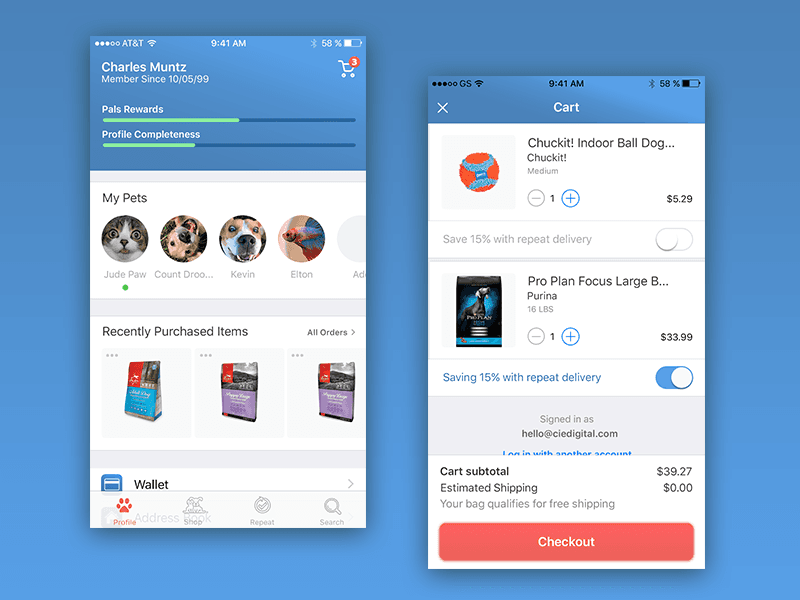
I introduced roadmaps and feature prioritization to focus on what mattered most; repeat orders, personalized recommendations, and subtle prompts for profile completion.
From overwhelmed to a trusted companion
We launched Petco’s first personalized app experience, supported by a scalable design system and refined through iterative testing. Pet-parents finally had clear, tailored guidance.
Petco drove deeper engagement through richer profiles and repeat purchases.
With this new product, customers could subscribe to the products they need and love. But from a business side, it increased cart totals and fully realized an omnichannel experience.
Petco
Petco is a category leading pet health and wellness retailer offering products and services through a nationwide store footprint and digital channels.
5
2017
Key Outcomes
4.7 ☆ App Store rating
Increased cart totals
Launched pet-centric personalization engine
Key Activities
Mixed-Method User Research
Experience Pillar Definition
Information Architecture
Experience Flow Design
User Experience Design
Creative Direction
User Interface Design
Large Scale Conditional Prototyping
Hi-Fidelity Interaction Prototyping
User Interface Design